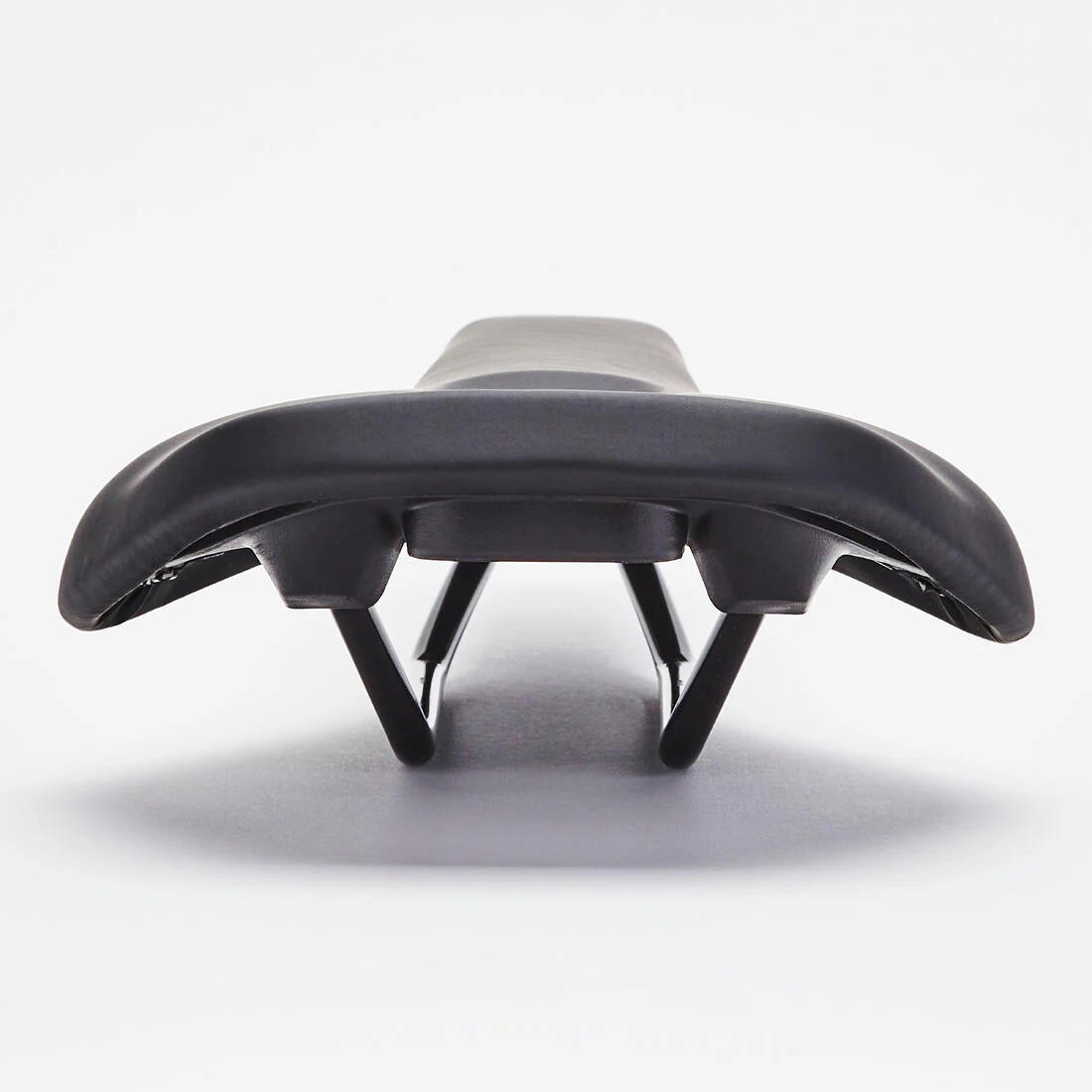


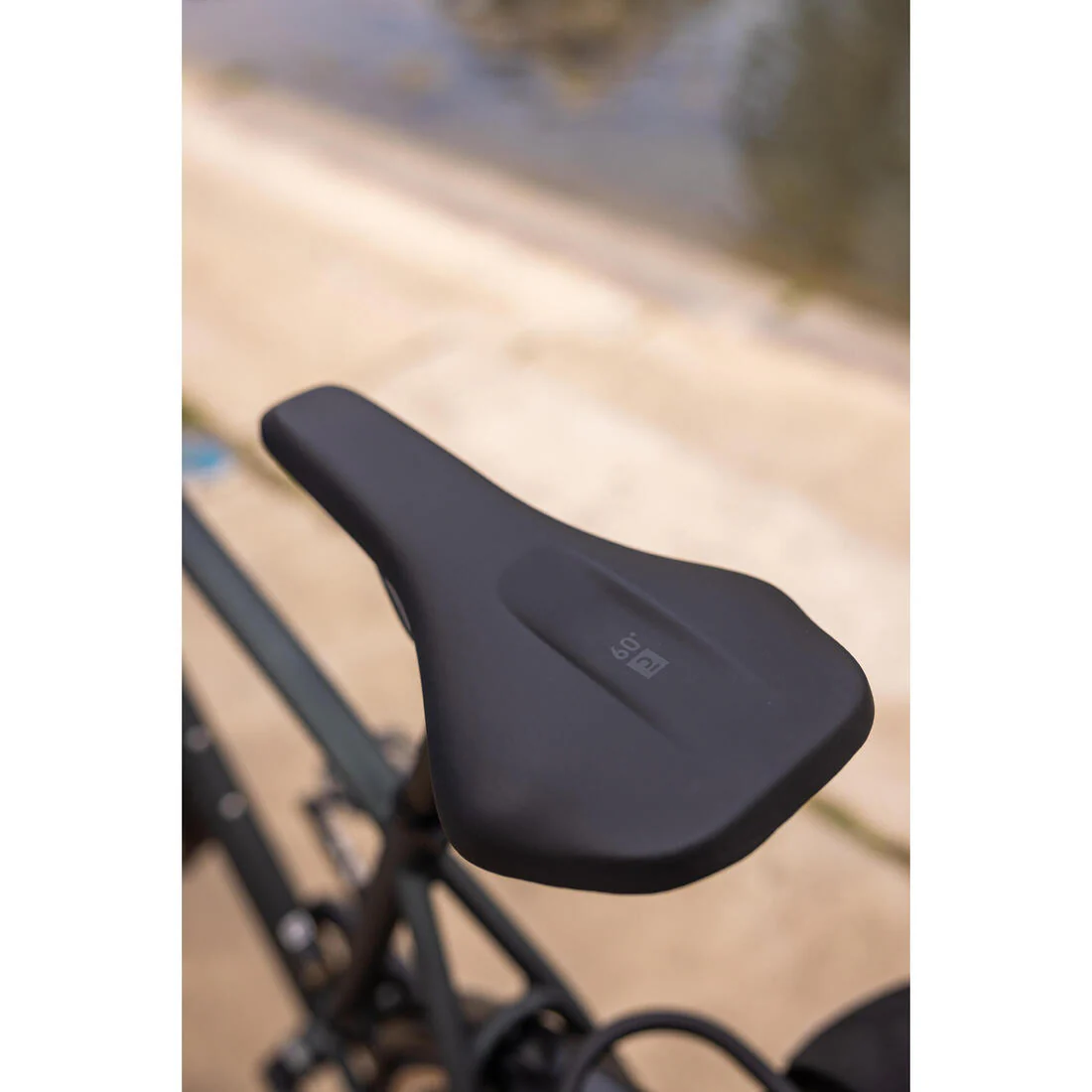


60° MD MTB / TREKKING / BIKE SADDLE
We designed this saddle for frequent bike rides of between 1 and 3 hours with a 60° torso angle. Suitable for body types: men and women.
Features:
270 mm x 160 mm
Compatibility:
Compatible with all brands of seatpost with 7 mm rails.
How to choose your saddle according to your riding style
A saddle adapted to your position for guaranteed comfort. Straight back (90°): Wide, padded saddle for greater comfort Inclined position (60°): Versatile saddle Low position (30°): Thin, moulded saddle to improve performance
Choosing the right saddle width
Here are some simple benchmarks: - If the gap between your sit bones is between 90 and 120 mm, use a 145 mm saddle - If between 120 and 140 mm, a 155 mm saddle will be more comfortable - In a raised position (45 to 60°), choose a 155 mm saddle, even if the gap is smaller
Watch the tutorial video to measure your sit bone width:
You can also watch our tutorial video which will explain all the steps described above: https://players.brightcove.net/3415345270001/DOHosj6Wy_default/index.html?videoId=ref:p2575062_1
Making the most of your ride:
Saddle adjustment: 4 Steps for optimal comfort Choosing a saddle: suitable for your posture (back at 60° = special saddle). Height: the leg needs to extend without unbalancing the pelvis. Angle: neutral to avoid pain and the wrong pressure. Backward/forward: knees properly aligned with the pedals. You can see a video demonstration here: https://www.youtube.com/watch?v=UI0w_ii3mkw
1. Determining the saddle height (part 1):
Equipment: Tape measure, rigid book, pencil Position: standing up, barefoot, back against a wall, feet 15 to 20 cm apart Action: raise the book between your legs up to the perineum Marker: mark the top of the book on the wall Measure: from the floor to your mark = your inseam height Essential information for choosing the right frame size.
1. Determining the saddle height (part 2):
To determine your inseam height, you need to multiply it by 0.883 = the ideal distance between the centre of the bottom bracket and the top of the saddle. Example: 89 cm x 0.883=78.6 cm This method is used by bike fitters for optimal positioning.
2. Adjusting the saddle angle:
A flat saddle is more comfortable! Place a spirit level on the front of the saddle (in the centre towards the tip). Adjust it until it is horizontal. Then tweak after a few rides until comfortable.
3. How to measure your sit-bone width
- Take two pieces of cardboard, a flat stool, a ruler and a pen. - Place the cardboard on the stool, sit up straight and apply pressure for one minute. - Stand up and locate the two marks. - Connect the centres with the ruler: this is your sit-bone gap! Handy for finding the best saddle for your personal use.
3. Adjusting the saddle setback:
How to adjust the saddle position (forward/back) - Get on your bike against a wall mount - Clip your shoes to the pedals - Place the crank parallel with the ground Look at your knee: It should be aligned with the pedal If not, move the saddle forward or back as required.
We've developed our new collection of saddles, designed in France at our Decathlon laboratories, for regular cycling, combining comfort, support and protection.
Sitting comfort
Wide, ergonomic saddle for better weight distribution.
Anatomic design
The central part relieves pressure on the perineum. Unisex.
Modularity
Accessories can be added: sports action cameras.
We designed this saddle for frequent bike rides of between 1 and 3 hours with a 60° torso angle. Suitable for body types: men and women.
Original: $29.83
-70%$29.83
$8.95Product Information
Product Information
Shipping & Returns
Shipping & Returns
Description
We designed this saddle for frequent bike rides of between 1 and 3 hours with a 60° torso angle. Suitable for body types: men and women.
Features:
270 mm x 160 mm
Compatibility:
Compatible with all brands of seatpost with 7 mm rails.
How to choose your saddle according to your riding style
A saddle adapted to your position for guaranteed comfort. Straight back (90°): Wide, padded saddle for greater comfort Inclined position (60°): Versatile saddle Low position (30°): Thin, moulded saddle to improve performance
Choosing the right saddle width
Here are some simple benchmarks: - If the gap between your sit bones is between 90 and 120 mm, use a 145 mm saddle - If between 120 and 140 mm, a 155 mm saddle will be more comfortable - In a raised position (45 to 60°), choose a 155 mm saddle, even if the gap is smaller
Watch the tutorial video to measure your sit bone width:
You can also watch our tutorial video which will explain all the steps described above: https://players.brightcove.net/3415345270001/DOHosj6Wy_default/index.html?videoId=ref:p2575062_1
Making the most of your ride:
Saddle adjustment: 4 Steps for optimal comfort Choosing a saddle: suitable for your posture (back at 60° = special saddle). Height: the leg needs to extend without unbalancing the pelvis. Angle: neutral to avoid pain and the wrong pressure. Backward/forward: knees properly aligned with the pedals. You can see a video demonstration here: https://www.youtube.com/watch?v=UI0w_ii3mkw
1. Determining the saddle height (part 1):
Equipment: Tape measure, rigid book, pencil Position: standing up, barefoot, back against a wall, feet 15 to 20 cm apart Action: raise the book between your legs up to the perineum Marker: mark the top of the book on the wall Measure: from the floor to your mark = your inseam height Essential information for choosing the right frame size.
1. Determining the saddle height (part 2):
To determine your inseam height, you need to multiply it by 0.883 = the ideal distance between the centre of the bottom bracket and the top of the saddle. Example: 89 cm x 0.883=78.6 cm This method is used by bike fitters for optimal positioning.
2. Adjusting the saddle angle:
A flat saddle is more comfortable! Place a spirit level on the front of the saddle (in the centre towards the tip). Adjust it until it is horizontal. Then tweak after a few rides until comfortable.
3. How to measure your sit-bone width
- Take two pieces of cardboard, a flat stool, a ruler and a pen. - Place the cardboard on the stool, sit up straight and apply pressure for one minute. - Stand up and locate the two marks. - Connect the centres with the ruler: this is your sit-bone gap! Handy for finding the best saddle for your personal use.
3. Adjusting the saddle setback:
How to adjust the saddle position (forward/back) - Get on your bike against a wall mount - Clip your shoes to the pedals - Place the crank parallel with the ground Look at your knee: It should be aligned with the pedal If not, move the saddle forward or back as required.
We've developed our new collection of saddles, designed in France at our Decathlon laboratories, for regular cycling, combining comfort, support and protection.
Sitting comfort
Wide, ergonomic saddle for better weight distribution.
Anatomic design
The central part relieves pressure on the perineum. Unisex.
Modularity
Accessories can be added: sports action cameras.
We designed this saddle for frequent bike rides of between 1 and 3 hours with a 60° torso angle. Suitable for body types: men and women.